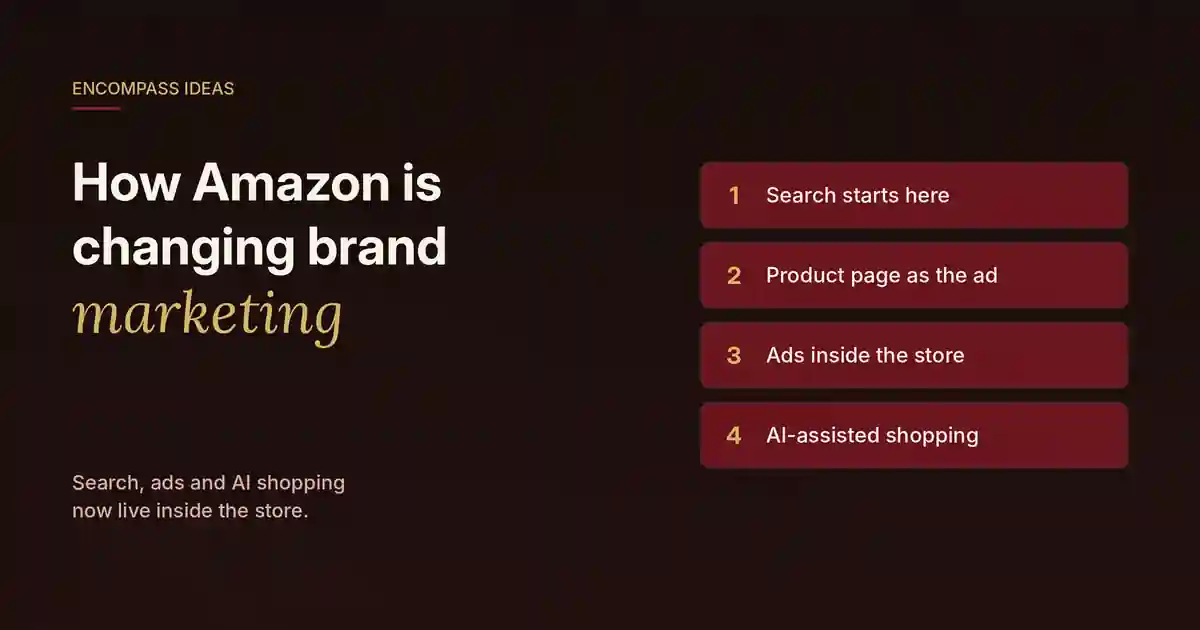
For a long time, brands treated Amazon as a sales channel: list the products, keep stock levels healthy, and let the marketplace do the rest. That view no longer holds. Amazon has become the place where many shoppers begin their search, one of the world's largest advertising businesses, and increasingly a store where an AI assistant helps people decide what to buy.
Each of those shifts changes what marketing on Amazon needs to do. Here's what has changed, and how brands can respond.
Amazon Is Where Product Searches Start
In a 2023 Jungle Scout survey, 57% of US online shoppers said they start their product searches on Amazon. That makes Amazon less like a shop at the end of the journey and more like a search engine at the start of it.
The implication is simple: for many categories, your Amazon search ranking and product page are part of your brand's first impression, not just the checkout.
The Marketplace Is Huge, and Crowded
Marketplace Pulse estimates that Amazon and its sellers sold about $830 billion worth of goods in 2025, with third-party sellers accounting for 61 to 62% of units sold. Most of what shoppers buy on Amazon comes from independent sellers and brands, not Amazon itself.
That scale is the opportunity. It's also the challenge: on almost any search results page, your product sits next to several direct competitors, often at similar prices. Standing out is a marketing problem, not just an operations one.
Your Product Page Is Now Your Most Important Ad
On Amazon, the product detail page does the work a brand website, a salesperson and a brochure would do elsewhere. Amazon itself says Basic A+ Content can increase sales by up to 8%, and well-implemented Premium A+ Content by up to 20%. A+ Content is available to brands enrolled in Amazon Brand Registry.
The pages that convert tend to get the basics right:
- Titles that use the words shoppers actually search for
- Images that show the product, its scale and how it's used
- Bullet points that answer the questions buyers ask before they buy
- A+ Content that tells the brand story and explains benefits visually
- A Brand Store that lets shoppers explore your full range
- Reviews and ratings managed through legitimate programmes, never incentivised
Advertising Has Moved Inside the Store
Amazon's advertising revenue passed $68 billion in 2025, with $21.3 billion in the fourth quarter alone, up 22% year over year. Most of that still comes from sponsored product listings on the marketplace, but Amazon is building out the full funnel: Amazon said its ad-supported Prime Video reached 315 million viewers in the fourth quarter of 2025.
For brands, this means Amazon advertising isn't a small tactical budget anymore. It's a channel that needs the same planning as search or social:
- Sponsored Products to win visibility on high-intent searches
- Sponsored Brands to build recognition for your brand and range
- Display and video to reach shoppers before and after they search
- Clear rules on which campaigns are for growth and which are for profit
Measured well, Amazon ads work alongside your wider performance marketing rather than competing with it for budget.
AI Is Changing How Shoppers Find Products
Amazon's AI shopping assistant, Rufus, is changing the path to purchase. On its October 2025 earnings call, Amazon said 250 million shoppers had used Rufus that year, that customers who use it are 60% more likely to complete a purchase, and that it expected Rufus to drive over $10 billion in annual incremental sales.
Advertising is following. In late November 2025, Amazon rolled out Sponsored Prompts: suggested Rufus questions tied to a product or brand, generated from your product page, Brand Store and campaign keywords.
When an assistant answers the shopper's questions, your product content has to contain the answers.
Pages written only for keywords will struggle. Pages that clearly explain who the product is for, how it works and why it's different give AI tools, and shoppers, what they need.
What This Means for Brands in India
The same shifts are playing out on Amazon.in. In August 2025, Amazon said it had more than 1.6 million sellers in India, over 90% of them small and medium businesses and more than half in tier 2, 3 and 4 cities. It also announced zero referral fees on over 1.2 crore products priced below ₹300.
Lower barriers bring more sellers, and more sellers make differentiation matter more. For D2C brands, that means competing on brand, content and customer experience, not just price.
How Brands Should Adapt
- Treat Amazon as a brand channel, not just a sales channel. Your listings, Brand Store and ads should carry the same positioning as your website and social media.
- Connect on-Amazon and off-Amazon marketing. Social, influencer and search activity can all drive shoppers to your Amazon listings, and Amazon data can shape what you say elsewhere.
- Write product content that answers questions. Assume shoppers and AI assistants will look for clear answers on fit, use, ingredients and benefits.
- Measure profit, not just ad return. Track total sales, margins and repeat purchases alongside advertising metrics.
- Protect the brand. Use Brand Registry to control your content and act on listings that misuse your brand.
Where Encompass Ideas Fits
Our Amazon marketing and marketplace growth work treats Amazon as part of a brand's wider growth system, connecting listings, advertising and brand strategy. For Revité, that meant 6.5X Amazon revenue within three months. You can read more in our case studies .
Where to go next
Amazon works best inside a clear overall plan. Read Marketing Strategy Basics: How to Build a Plan That Actually Works , or see how to bring shoppers in from social with Social Media Funnels That Actually Convert .
Sources
Search behaviour: eMarketer, citing Jungle Scout Consumer Trends Report Q2 2023 . Marketplace size: Marketplace Pulse, February 2026 . A+ Content: Amazon . Advertising revenue: Marketing Dive, February 2026 . Rufus: Fortune, November 2025 . Sponsored Prompts: Intentwise, November 2025 . Amazon India: Amazon India press release, August 2025 .