Customer lifetime value (CLV or LTV) is the total amount a customer spends with your business over the whole relationship. Shopify defines it the same way. For a D2C brand it answers a practical question: how much can you afford to pay to win a customer, given what that customer is likely to be worth?
How do you calculate customer lifetime value?
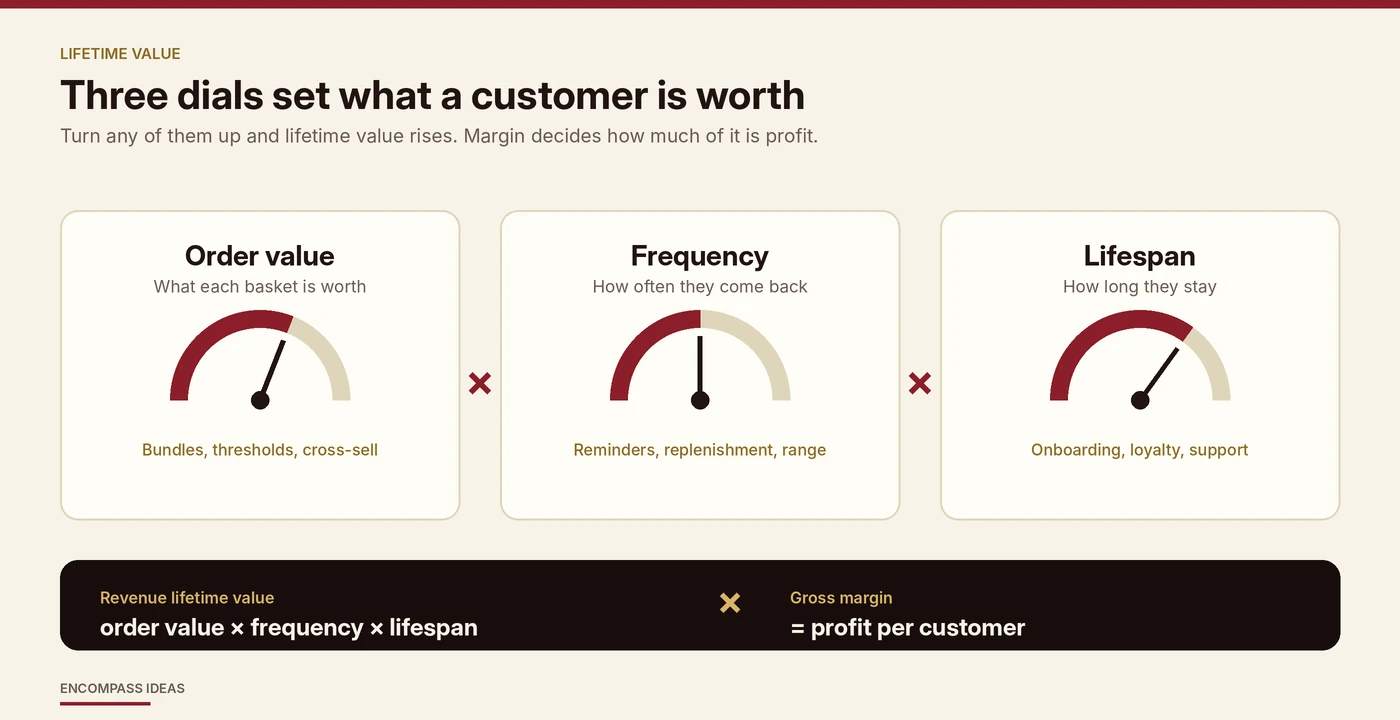
The basic formula is average order value multiplied by purchase frequency multiplied by average customer lifespan. Shopify's guide breaks each part down.
Illustrative example, not real client data: INR 900 × 2.5 orders a year × 2 years = INR 4,500 of revenue.
| Input | How to work it out |
|---|---|
| Average order value (AOV) | Total revenue ÷ total number of orders |
| Purchase frequency | Orders in a year ÷ unique customers who bought in that year |
| Average customer lifespan | The average length of the customer relationship, for example in years |
Illustrative example: INR 4,500 × 55% gross margin = INR 2,475.
Why does revenue-based LTV mislead?
Because you pay for products, shipping, returns and fees out of revenue. If you compare revenue-based LTV with a CAC that has to be paid from gross profit, every ratio looks better than it is.
- 7.5 : 1 LTV to CAC on revenue With a CAC of INR 600
- About 4.1 : 1 LTV to CAC on margin The number to decide with

What is a good LTV to CAC ratio?
Shopify says a 3:1 LTV-to-CAC ratio is the benchmark but that your target depends on your margins and operating costs. The idea is usually traced to David Skok, who wrote that the best SaaS businesses have a ratio above 3 and recover CAC within 12 months, and who stressed that these are only guidelines. They were written for software companies, so use them as a starting point for a D2C brand, not a rule.
| If your ratio is… | It may mean… |
|---|---|
| Well below 3:1 on a margin basis | You may be paying too much for customers, or not keeping them long enough |
| Far above 3:1 | You may be under-investing in growth, if payback is also fast |
| Any ratio | Read it together with payback time. A healthy ratio that takes years to pay back can still strain cash |
How can you raise customer lifetime value?
-
Raise order value
Bundles, tiered offers and free-shipping thresholds lift AOV, and Shopify lists upselling and cross-selling related or higher-value products among its CLV tactics.
-
Increase purchase frequency
Timed reminders and a catalogue that gives existing customers something new to buy, which Shopify also recommends, bring people back sooner.
-
Extend lifespan
Reward repeat purchase through loyalty or subscription incentives, and fix onboarding so customers use the product properly.
-
Improve gross margin
Better pricing, lower returns and cheaper fulfilment raise the profit in every order, which lifts margin-adjusted CLV without changing customer behaviour.
-
Remove checkout friction
Faster payment options for returning customers, another Shopify tactic, make the next order easier.
What mistakes should you avoid with LTV?
Related reading: how India's D2C brands have evolved explains why profitable, repeat-led growth now matters. Our post on customer acquisition cost covers the other half of the ratio. If you want help working out the numbers behind your growth plan, see our strategic brand growth consulting service .
The takeaway
Sources
Michael Keenan, updated by Mina Son, Shopify, Customer Lifetime Value: How To Calculate CLV (page dated 8 October 2026).
David Skok, For Entrepreneurs, SaaS Metrics 2.0: A Guide to Measuring and Improving What Matters (undated page; includes a 2016 update note). The 3:1 and 12-month figures are Skok's guidelines for SaaS businesses.
Photo credit: Blake Wisz on Unsplash . Diagrams by Encompass Ideas.