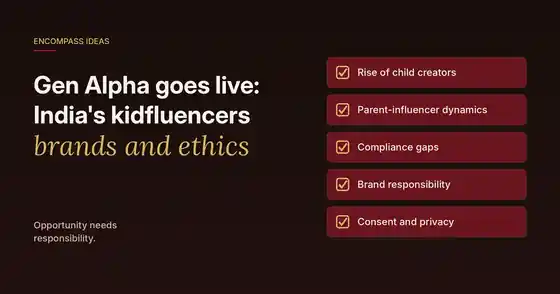
Gen Alpha, the generation growing up with smartphones and short video, is starting to shape what families watch, ask for and buy. For brands, the opportunity is real, but so is the responsibility. Young people do not make buying decisions alone, and the way a brand reaches them says a lot about its values.
This is an editorial discussion, not legal advice. Rules on advertising to children and on children's data are changing, so please take qualified advice before running any campaign aimed at young audiences.
Parents are the audience too
In most families, parents decide what is bought and what is watched. A campaign for young audiences is therefore also a campaign for parents. Content that parents find honest, useful and safe earns trust. Content that feels pushy or intrusive loses it.
Where child creators fit in
afaqs reported in July 2025 that India had 83,212 Instagram kid influencers under 16 as of March 2025, up 41% on the year before. The article does not name the source of the count, and a peer-reviewed paper published the same month cites "over 75,000", so treat any single figure as an estimate. The same article estimates the kidfluencer economy at ₹150–200 crore a year, an estimate from a creator platform rather than independent data. Active categories include FMCG, edtech, kids' fashion, toys and OTT.
A 2025 peer-reviewed study in Social Media + Society (Sarwatay) notes that in these arrangements parents and other adults, not the children, make the content and brand-deal decisions, and raises concerns about exploitation and wellbeing in what it calls a "regulatory vacuum". Public debate is growing: in December 2025, Sudha Murty told the Rajya Sabha that "kids are not content", according to The Logical Indian.
Our view: for most brands, working with parents and family creators, rather than building campaigns around a child's own content, is the lower-risk, more sustainable route.
Principles that hold up whatever the rules become
- Put parents or guardians in the loop, transparently and in writing.
- Label paid and gifted content clearly. ASCI's disclosure rules apply to influencer content.
- Avoid advertising that exploits young people's inexperience. The ASCI Code says advertising should not cause children physical, mental or moral harm or exploit their vulnerability.
- Treat children's data with particular care. India's Digital Personal Data Protection Act treats anyone under 18 as a child and requires verifiable parental consent to process a child's data, with phased commencement of the Rules. Confirm current dates and your obligations with counsel.
- Respect platform settings. Instagram introduced Teen Accounts in India in February 2025, with private-by-default settings and parental approval for under-16s to loosen them.
- Keep content age-appropriate and avoid anything that puts a child at risk.
What this means for brand strategy
- Build trust with the family, not just attention from the child.
- Prefer education, entertainment and storytelling with clear value over hard selling.
- Choose creators, including parent creators, whose values match yours, and brief them in writing.
- Measure on trust and repeat purchase as well as reach.
Final thoughts
Gen Alpha will be a major audience for years to come. The brands that handle it well will put families first and treat responsibility as part of the strategy, not an afterthought.
Sources
afaqs, "Little creators, big pay cheques", 17 July 2025: afaqs.com
Sarwatay, Social Media + Society, 2025: journals.sagepub.com
The Logical Indian, 9 December 2025: thelogicalindian.com
S.S. Rana on the final DPDP Rules: ssrana.in
The ASCI Code: ascionline.in
Meta, Teen Accounts in India, 11 February 2025: about.fb.com
Where to go next
Read about our Influencer & UGC Marketing approach, or see how user-generated content builds trust .