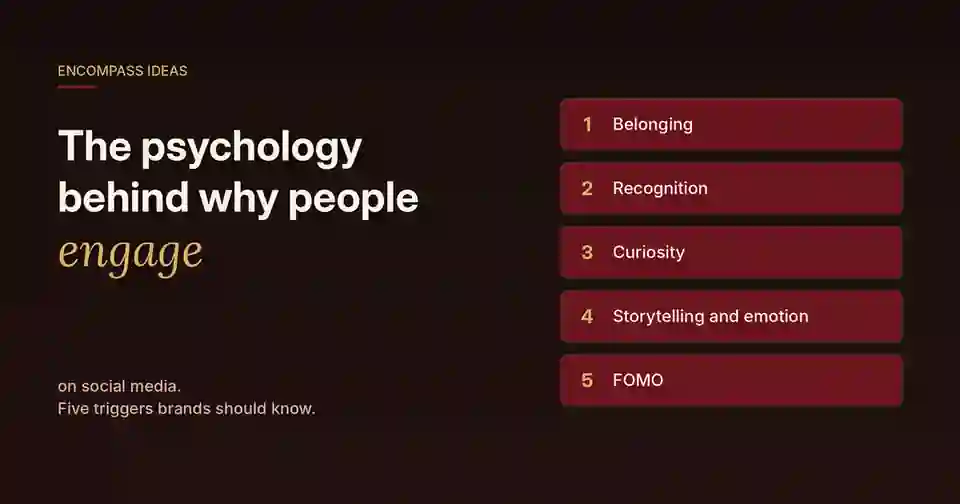
People spend a large part of their day on social media, but not every brand earns their attention. Understanding why people engage helps. Here are five triggers, with what published research does and does not support.
The audience in India
DataReportal's Digital 2026 India report counts about 500 million social media user identities in late 2025, equal to 34.1% of the population, with 481 million Instagram users and 500 million on YouTube. Reported daily time varies by source and method (one report says 3.2 hours, another 2 hours 29 minutes), so we do not quote a single figure.
1. Belonging and connection
People want to feel part of something. Communities and shared interests make content that reflects who they are more engaging. This is a practical marketing observation rather than a measured result.
2. Recognition and validation
A 2016 study of 32 teenagers aged 13 to 18, summarised by the Association for Psychological Science, found photos with many likes triggered more activity in a reward-related brain region, and teens were more likely to like photos that already had many likes, whatever the content. The sample is small and young, so it shows the pull of social validation, not a rule for every audience.
3. Curiosity and learning
A how-to, a surprising fact or a behind-the-scenes look invites people to stop and find out more. We found no strong study on this specific trigger, so treat it as craft knowledge to test.
4. Storytelling and emotion
Berger and Milkman (Journal of Marketing Research, 2011) analysed 6,956 New York Times articles and three lab studies. Content that evokes high-arousal emotions, such as awe or anger, was shared more than content that evokes low-arousal emotions such as sadness. The study covered news articles, not brand content, so use it as a guide to test, not a guarantee.
5. Fear of missing out (FOMO)
Przybylski and colleagues (2013) defined FOMO as a pervasive apprehension that others might be having rewarding experiences from which one is absent. Across three studies, younger people reported higher FOMO, and higher FOMO went with more social media engagement. These are correlations, not proof of cause. Used honestly for launches or limited editions, urgency can help. Used manipulatively it erodes trust.
A caution on dopamine claims
Popular articles describe likes as dopamine hits. The research we found supports the narrower point that likes engage reward-related brain regions. We would not build a strategy on addiction claims.
Final thoughts
Start with the human need, then build the content. Test each trigger with your own audience and let your results, not rules of thumb, decide.
Sources
Berger and Milkman, What Makes Online Content Viral, 2011: faculty.wharton.upenn.edu
Przybylski et al., Computers in Human Behavior, 2013: selfdeterminationtheory.org
Association for Psychological Science on Sherman et al., 31 May 2016: psychologicalscience.org
DataReportal, Digital 2026: India: datareportal.com
Where to go next
See our Social Media & Content Marketing service, or read about the power of user-generated content .