Customer acquisition cost (CAC) is the total sales and marketing spend needed to win one new customer, divided by the number of new customers won in the same period. If a brand spends INR 5,00,000 in a month and wins 1,000 first-time customers, its CAC is INR 500.

Illustrative example: INR 5,00,000 ÷ 1,000 new customers = INR 500 per customer.
How do you calculate CAC?
Add up your acquisition costs for a period, then divide by the number of first-time customers in that same period. Shopify's guide to CAC uses the same approach and excludes returning customers from the count. Two rules keep the number honest:
What should you include in CAC?
Shopify lists marketing software, staff salaries, advertising fees, discounts and promotional offers, and content creation among the costs that belong in CAC. Our suggested rule is simple: include everything you would stop spending if you stopped acquiring new customers.
Include in CAC
- Ad spend on every paid channel
- Creator and influencer fees, including free product sent out
- Agency and freelancer fees
- Marketing tools and the share of staff time spent on acquisition
- Discounts given to first-time buyers, such as welcome codes
Leave out of CAC
- Spend on reminding or reselling to existing customers
- Costs you would still pay if you stopped acquiring new customers
Whichever rule you choose, write it down and keep it fixed. A CAC that changes definition every quarter cannot be compared with itself.
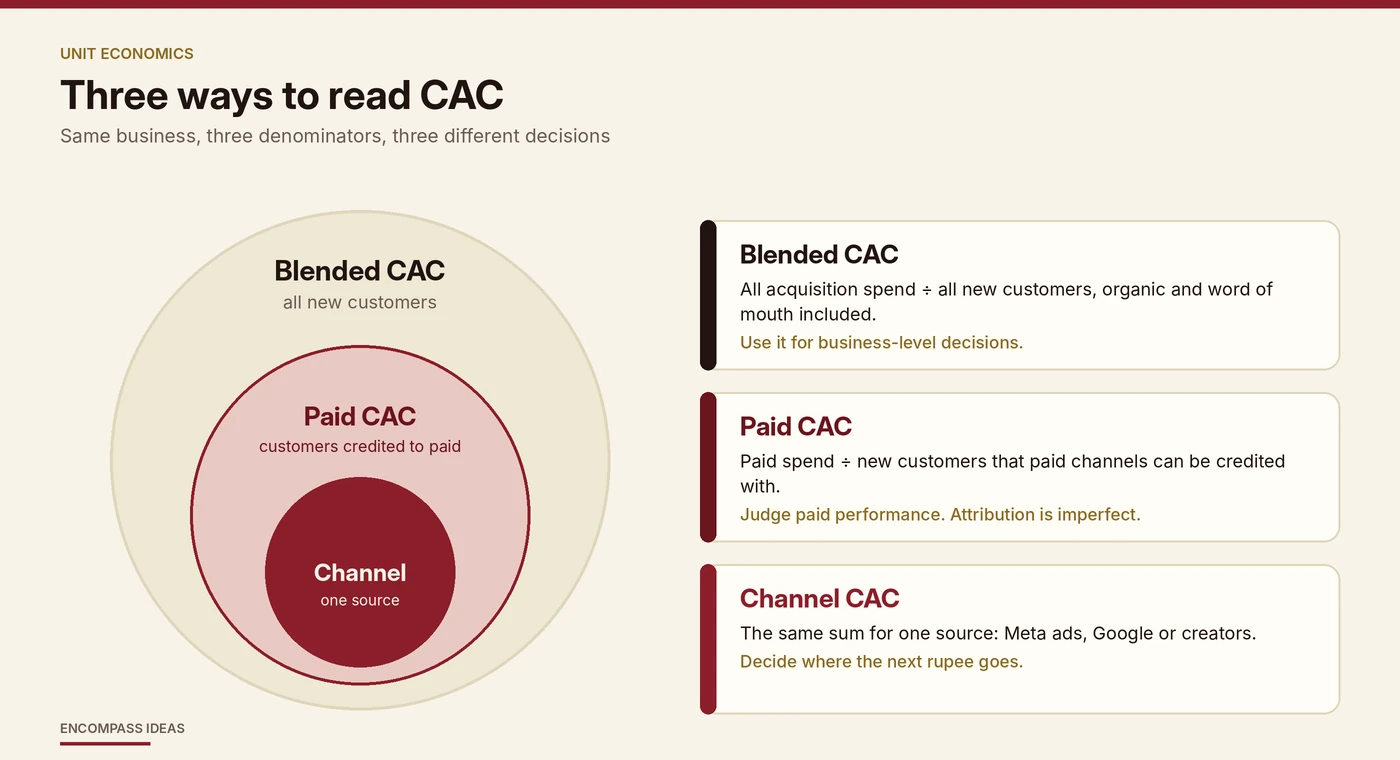
What is the difference between blended, paid and channel CAC?
| Type | What it is | Use it to |
|---|---|---|
| Blended CAC | All acquisition spend ÷ all new customers, including organic and word of mouth | Make business-level decisions |
| Paid CAC | Paid spend ÷ new customers that paid channels can be credited with | Judge paid performance, knowing attribution is imperfect |
| Channel CAC | The same calculation for one channel, such as Meta ads, Google or creators | Decide where the next rupee goes |
Illustrative example, not real client data: a brand spends INR 5,00,000 in a month and wins 1,000 first-time customers.
- INR 500 Blended CAC INR 5,00,000 ÷ all 1,000 new customers
- About INR 633 Paid CAC INR 3,80,000 of ads and creators ÷ the 600 customers traced to them
Blended CAC is lower because organic and direct customers are in the denominator.
What is a good CAC for a D2C brand?
There is no universal figure. A good CAC is one your margins can pay back in a time you can afford. Two checks help.
-
CAC payback
How long it takes a customer's gross profit to cover what you paid to acquire them.
-
LTV to CAC ratio
Customer lifetime value divided by CAC. Shopify recommends a ratio of 3:1 to 5:1.
The best-known version of the 3:1 idea is David Skok's, who said the best SaaS businesses have a ratio above 3 and recover CAC within 12 months. He called these guidelines, and they were written for software companies, so treat them as a starting point for a D2C brand, not a target.
How can you reduce CAC?
-
Test creative systematically
A better hook or proof point lowers the cost of every click that follows.
-
Improve landing-page and checkout conversion
If conversion rises from 2% to 3% at the same traffic cost, cost per customer falls by a third.
-
Rework the offer
Bundles and gifts can raise first-order value without cutting price.
-
Shift budget by channel CAC
Move spend from channels whose CAC is above your limit to those below it, and retest regularly.
-
Build organic and referral sources
Shopify notes organic leads tend to be more cost-effective than paid acquisition, though they take longer to build.
-
Improve retention
It does not lower CAC, but repeat orders shorten payback and raise the CAC you can afford.
What mistakes distort CAC?
Related reading: ROAS vs ROI: which number should a D2C founder watch? explains how CAC and ROAS relate to margin, and performance marketing: a guide for businesses covers the wider channel picture. Our next post covers customer lifetime value, the other half of the ratio. For help bringing CAC down, see our performance marketing and customer acquisition service .
The takeaway
Sources
Dayna Winter, Shopify, Customer Acquisition Cost (CAC): Calculate and Reduce It (29 July 2024).
David Skok, For Entrepreneurs, SaaS Metrics 2.0: A Guide to Measuring and Improving What Matters (undated page; includes a 2016 update note). The 3:1 and 12-month figures are Skok's guidelines for SaaS businesses.
Photo credit: M. Cooper on Unsplash . Diagrams by Encompass Ideas.