
A customer retention strategy is a plan to make existing customers buy again by improving what happens after the first order: onboarding, reminders, loyalty, content and win-back. For a D2C brand it matters because a repeat order usually costs less to win than a first order, and repeat buyers raise the lifetime value of every customer you acquire.

Why does customer retention matter for D2C brands?
Because acquiring customers is expensive and retention improves the return on that spend. Two widely repeated claims show the direction, though not the size, of the effect.
What the research is quoted as saying
- 5-25x Cost of winning vs keeping a customer Quoted in Harvard Business Review: "depending on which study you believe"
- 25-95% Profit lift from 5% higher retention Attributed to Bain's Frederick Reichheld; Bain's own 2006 article calls it a theory
How do you measure retention?
Use three measures, and count customers rather than orders.
| Measure | What it tells you | How to calculate it |
|---|---|---|
| Repeat purchase rate | Share of customers who come back | Customers with two or more orders ÷ all customers who ordered in the period |
| Time between orders | When to send reminders | Median days from first to second order |
| Cohort retention | Whether newer customers behave better or worse | Group customers by first-order month, then track the % who buy again within 30, 60, 90 and 180 days |
Illustrative example: 600 customers ordered in April and 120 of them ordered at least twice, so the repeat rate is 120 ÷ 600 = 20%.
Keep the window consistent. A consumable that lasts a month will show repeat orders far sooner than a product bought once or twice a year, so compare like with like.
When should you ask a customer to reorder?
Work it out from how long the product lasts. This is a method, not a benchmark.
Illustrative example: 60 capsules taken twice a day last 30 days. With 4 days for a reorder to arrive and a 5-day buffer, the reminder goes out on day 21 after delivery.
Counted from the day the first order arrives.
-
Day 0
First order arrives
-
Day 21
Reminder goes out
-
Day 25
Reorder arrives, 5 days early
-
Day 30
Original pack runs out
Then check it against your own time-between-orders data and move the date until it matches how customers actually behave.
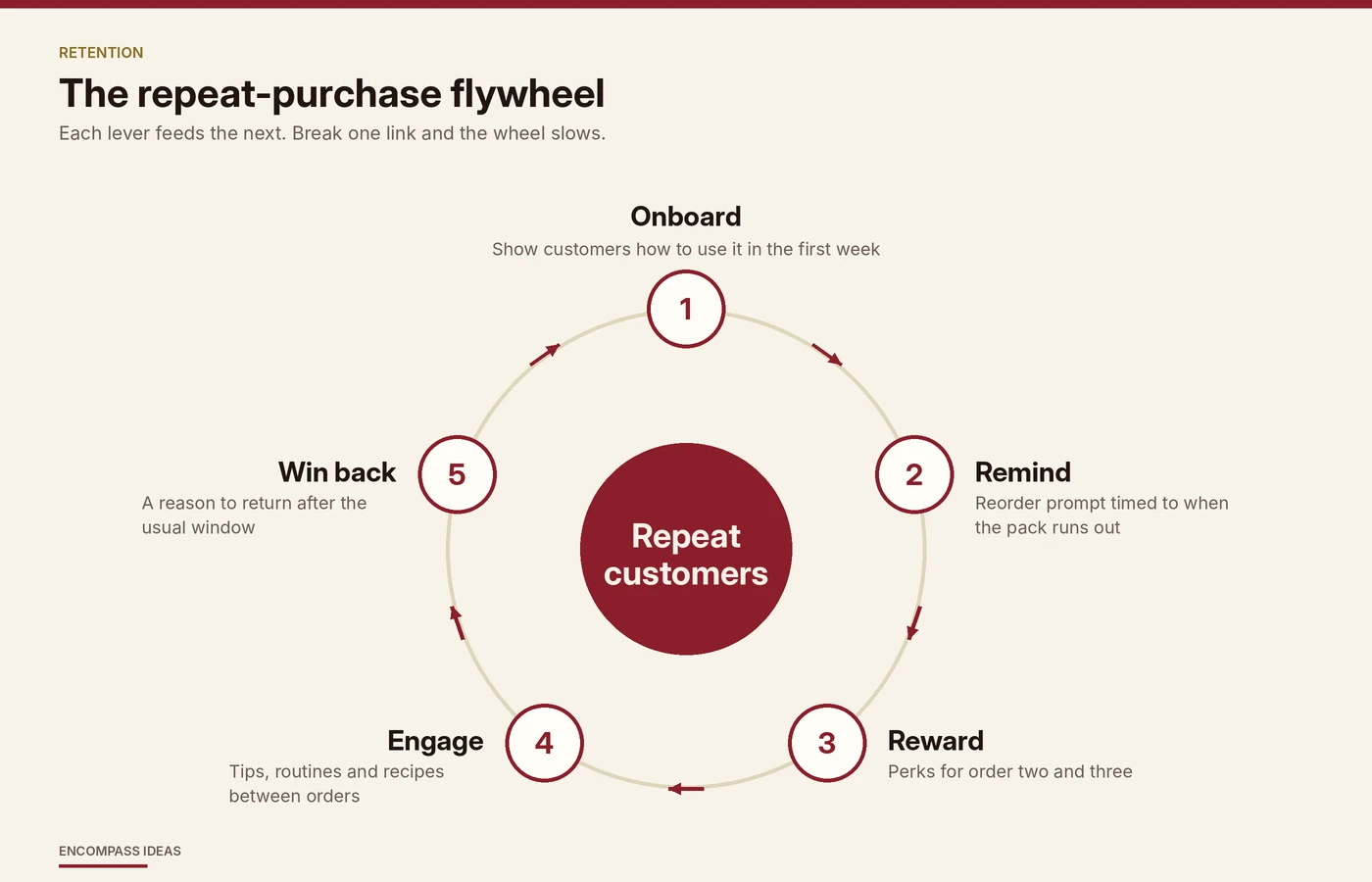
What are the five levers of retention?
-
Onboarding
Tell new customers how to use the product, what to expect and when, in the first week. Confusion after delivery is a common reason for no second order.
-
Replenishment and reminders
Use the formula above, by email or WhatsApp, with a one-tap reorder link.
-
Loyalty and rewards
Reward the second and third order, not just the first, and keep the rules simple enough to explain in a sentence.
-
Post-purchase content
Usage tips, routines, recipes or results tracking that give customers a reason to stay engaged between orders.
-
Win-back
Contact customers who have gone past their usual reorder window with a clear reason to return, and stop contacting those who do not respond.
What mistakes hurt retention?
Common mistake
- Treating discounts as the only lever
- Messaging everyone at the same time
- Measuring only revenue from repeat customers
- Skipping product quality and delivery
Do this instead
- Reward order two and three with perks, not only price cuts
- Trigger messages by days since last order
- Track how many came back, not just what they spent
- Fix the product and delivery first: no campaign fixes a product that disappoints
Related reading: how India's D2C brands have evolved explains why profitable repeat growth now matters more than easy acquisition, and the power of user-generated content in building trust covers one source of post-purchase content. For help setting up reminders and flows, see our retention marketing service for WhatsApp and email .
The takeaway
Sources
Amy Gallo, Harvard Business Review, The Value of Keeping the Right Customers (29 October 2014).
Bain & Company, Retaining customers is the real challenge (20 January 2006).
Photo credit: Rifki Kurniawan on Unsplash . Diagrams by Encompass Ideas.